
Audio to MIDI
Pitch detection gets you the notes. What you usually want next is a .mid file sitting in your DAW, quantized against a grid you can see. Tabtify does the detection, shows you the result as a tab you can fix, and exports MIDI from there.
Or drag and drop here
MP3, WAV, M4A, OGG, FLAC, AAC, AIFF, MP4, WEBM, .mid or .midi
GP5, GPX, GP, MusicXML, MXL
Guitar, bass, 7-string or ukulele. Free export to Guitar Pro, MIDI, PDF, and MusicXML.
AI-Powered Guitar Tab Generation
Paste a link or file, get an editable draft, then play and export in the browser.
01
Paste a link or upload audio
YouTube, TikTok, Instagram, MIDI, or a recording.
02
AI writes the tab draft
Notes and rhythm land as an editable guitar tab.
03
Play, tweak, export
Loop hard bars. Export GP5, MIDI, PDF, MusicXML.
Use cases
What players convert here
Sketch to arrangement
Hum or play an idea, convert it, then rebuild it in your DAW with any instrument you want.
Sampling a part you own
Pull the note data out of a stem you recorded and reprogram it with a different sound.
Scoring a part by ear, faster
Let the AI do the first pass on pitches and rhythm, then correct the handful it got wrong.
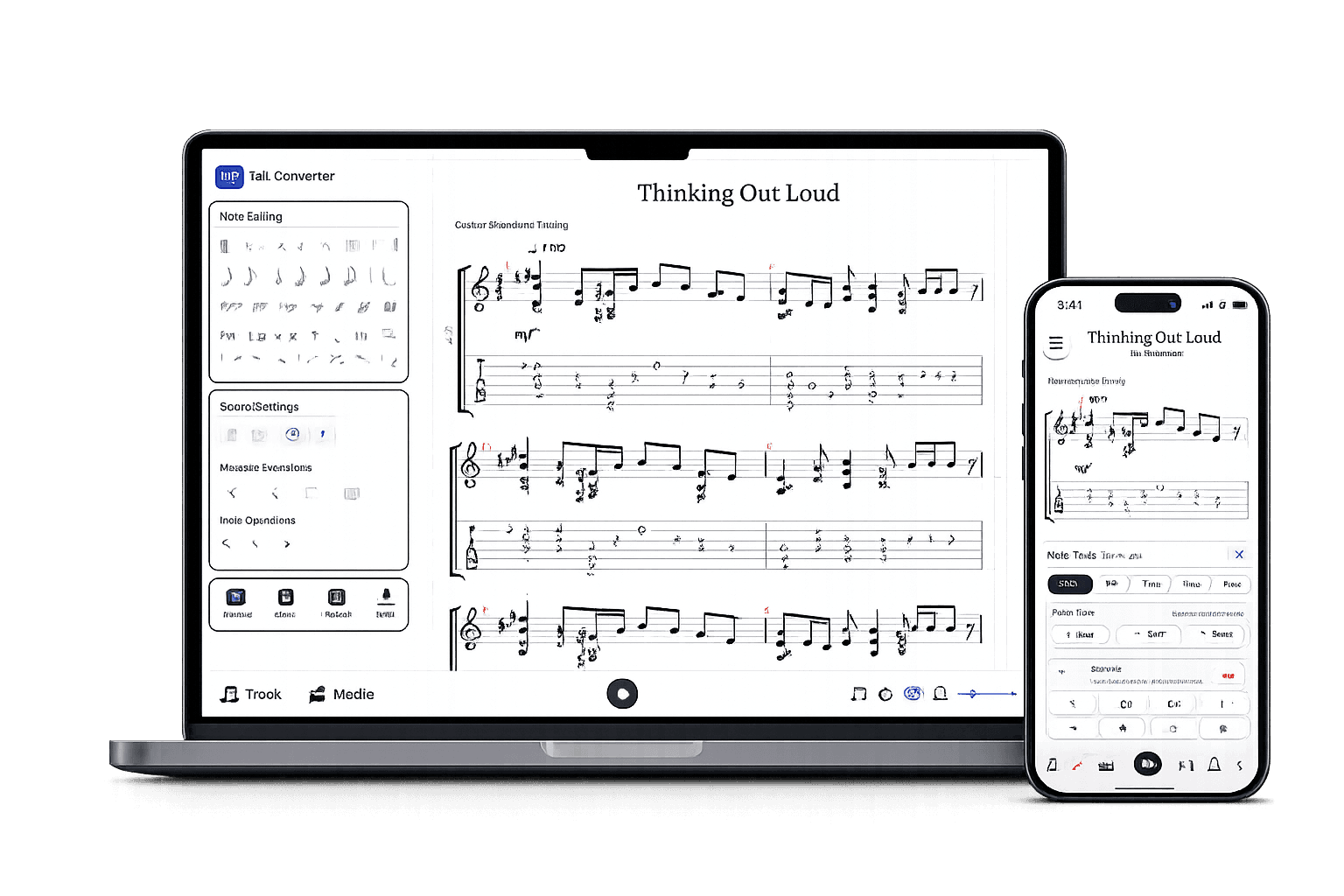
After the AI draft
A real tab editor, not a static download.
Play it back, edit any note, open GP5 or MusicXML you already have, and export in the format you need.
Edit the draft
Fix notes, timing, measures, and fret choices.
Check by ear
Play back, loop bars, match the source.
Export when ready
Guitar Pro, MIDI, PDF, MusicXML.
Tabs made by Tabtify
Open any of them in the editor: play along with media sync, change a note, export to Guitar Pro or PDF.
Boulevard of Broken Dreams
Green Day
Whole Lotta Love
Led Zeppelin
Master Of Puppets
Metallica
Californication
Red Hot Chili Peppers
American Idiot
Green Day
Wonderwall
Oasis
Blackbird
The Beatles
Basket Case
Green Day
Stairway To Heaven
Led Zeppelin
Bohemian Rhapsody
Jeff Beck
Highway to Hell
AC/DC
You Shook Me All Night Long
AC/DC
Frequently Asked Questions
Everything you need to know about Tabtify's AI-powered guitar tab creation platform. From audio conversion to professional export formats.
What file do I get at the end?
How accurate is it on chords?
Do I need to pay to export the MIDI?
Can I get a guitar tab out of the same conversion?
Does it keep the tempo?
Can I start from a YouTube link instead of a file?
Related converters
Other ways to start
Converter notes
From source to editable tab
These notes are here for setup context. The main workflow starts above in the converter, then continues in the editor.
- Exports a standard .mid file that opens in Ableton, Logic, FL Studio, and Reaper.
- Every note lands on an editable fretboard first, so you catch octave errors before export.
- Tempo and time signature come across with the notes.
Steps
- 01Upload your audio file in the Audio tab.
- 02Pick the instrument and tuning so the notes map to sensible positions.
- 03Run the conversion and open the result in the editor.
- 04Fix any wrong notes against playback, then export MIDI.
Source quality
- A single instrument playing alone converts far better than a full mix.
- Monophonic lines are the most reliable. Dense chord voicings are the hardest case.
- Trim the file to the section you actually need before uploading.
- MIDI carries pitch, timing, and velocity. It does not carry your tone, reverb, or effects.
- Overlapping instruments in one file confuse note detection, so isolated parts win.
- Conversion is built around sources up to 15 minutes.