
MP3 to Ukulele Tab
Have the song as an MP3? Upload it and Tabtify maps the melody or chords to a standard-tuned ukulele, returning an editable tab you can fix note by note.
Or drag and drop here
MP3, WAV, M4A, OGG, FLAC, AAC, AIFF, MP4, WEBM, .mid or .midi
GP5, GPX, GP, MusicXML, MXL
Guitar, bass, 7-string or ukulele. Free export to Guitar Pro, MIDI, PDF, and MusicXML.
AI-Powered Guitar Tab Generation
Paste a link or file, get an editable draft, then play and export in the browser.
01
Paste a link or upload audio
YouTube, TikTok, Instagram, MIDI, or a recording.
02
AI writes the tab draft
Notes and rhythm land as an editable guitar tab.
03
Play, tweak, export
Loop hard bars. Export GP5, MIDI, PDF, MusicXML.
Use cases
What players convert here
Learn a song from a track
Convert an MP3 of a song into a ukulele tab to learn the melody or picking part.
Fingerpicking arrangements
Turn a fingerstyle MP3 into notation and adjust the picking pattern in the editor.
Your own uke recordings
Export a practice take to MP3 and get an editable tab you can refine and share.
After the AI draft
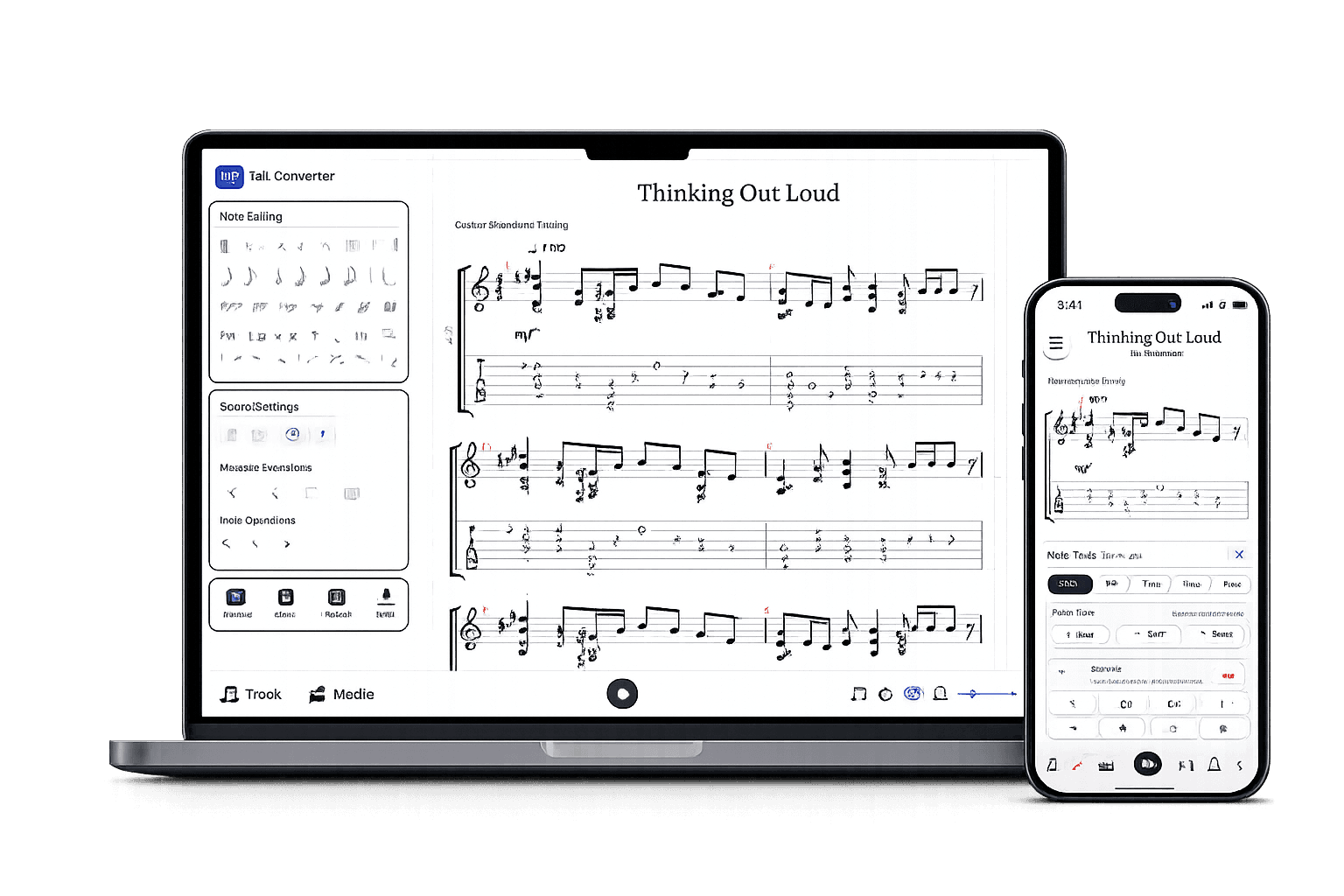
A real tab editor, not a static download.
Play it back, edit any note, open GP5 or MusicXML you already have, and export in the format you need.
Edit the draft
Fix notes, timing, measures, and fret choices.
Check by ear
Play back, loop bars, match the source.
Export when ready
Guitar Pro, MIDI, PDF, MusicXML.
Tabs made by Tabtify
Open any of them in the editor: play along with media sync, change a note, export to Guitar Pro or PDF.
When I'm 64
Alex Korsh
Scar Tissue
Red Hot Chili Peppers
Piratyi Karibskogo Morya
Piraty Karibskogo Morya
While My Guitar Gently Weeps
Jake Shimabukuro
november rain
Guns N Roses
Bohemian Rhapsody
Jeff Beck
American Idiot
Green Day
Fear Of The Dark
Iron Maiden
Welcome To the Jungle
Guns N Roses
Back In Black
AC/DC
Hysteria (intro)
Muse
Cocaine
Eric Clapton
Frequently Asked Questions
Everything you need to know about Tabtify's AI-powered guitar tab creation platform. From audio conversion to professional export formats.
Can Tabtify turn an MP3 into a ukulele tab?
Will it detect ukulele chords or single notes?
What if the song is out of ukulele range?
Related converters
Other ways to start
Converter notes
From source to editable tab
These notes are here for setup context. The main workflow starts above in the converter, then continues in the editor.
- Reads MP3 files directly, mapped to standard GCEA ukulele range.
- Best for melody lines, fingerpicking parts, and clear single-instrument passages.
- Opens in the editor so voicings and positions can be corrected before you play.
Steps
- 01Upload your MP3 file in the Audio tab.
- 02Choose ukulele and check the tuning before conversion; review chords and individual notes in the editor.
- 03Run AI transcription and open the ukulele tab in the editor.
- 04Refine voicings and timing with playback, then save or export.
Source quality
- Ukulele sits in a high, narrow range - clear, uncluttered MP3s transcribe best.
- Melody and fingerpicking passages map more cleanly than dense strummed full mixes.
- Choose ukulele and check the tuning before conversion; review chords and individual notes in the editor.
- Fast strumming and overlapping instruments can be hard to separate into individual notes.
- Parts recorded far outside standard ukulele range may be transposed to fit GCEA.
- AI output is a starting draft; expect some cleanup for rhythm and voicings.