
Vocal to Guitar Tab Converter
Use Tabtify to convert a vocal melody to guitar tab: upload your singing or humming, or a song with vocals, and the melody comes back as a tab draft on a guitar neck, ready to edit.
Or drag and drop here
MP3, WAV, M4A, OGG, FLAC, AAC, AIFF, MP4, WEBM, .mid or .midi
GP5, GPX, GP, MusicXML, MXL
Guitar, bass, 7-string or ukulele. Exports to Guitar Pro and MIDI.
AI-Powered Guitar Tab Generation
Paste a link or file, get an editable draft, then play and export in the browser.
01
Paste a link or upload audio
YouTube, TikTok, Instagram, MIDI, or a recording.
02
AI writes the tab draft
Notes and rhythm land as an editable guitar tab.
03
Play, tweak, export
Loop hard bars. Export GP5, MIDI, PDF, MusicXML.
Use cases
What players convert here
Sing-along melody on guitar
Play the vocal line of a song as a single-note guitar part to learn or teach it.
Your own melody idea
Record a hummed or sung idea and get a tab draft to build a riff or lead from.
Melody over the chords
Keep the guitar accompaniment track and read the vocal line above it.
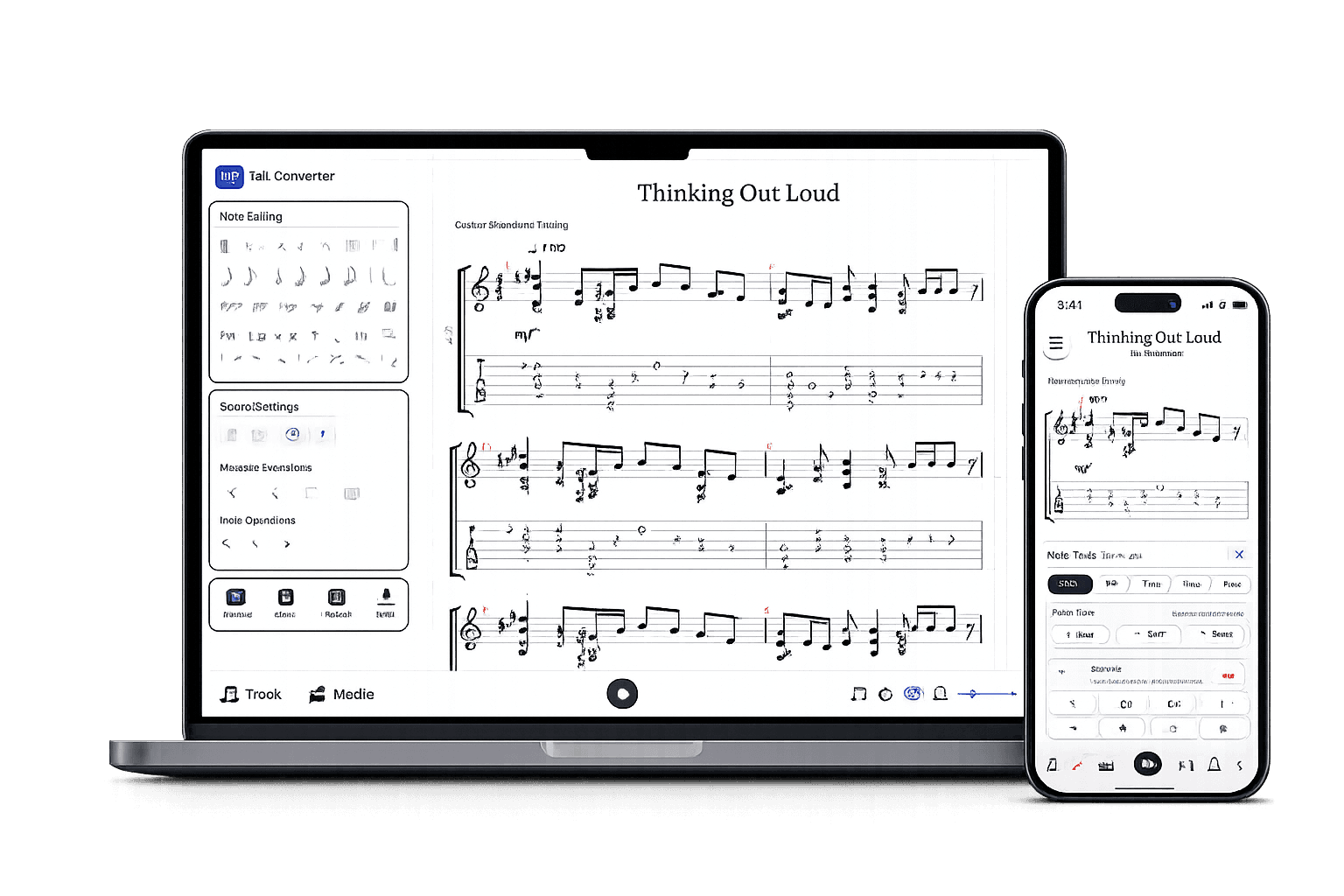
After the AI draft
A real tab editor, not a static download.
Play it back, edit any note, open GP5 or MusicXML you already have, and export in the format you need.
Edit the draft
Fix notes, timing, measures, and fret choices.
Check by ear
Play back, loop bars, match the source.
Export when ready
Guitar Pro, MIDI, PDF, MusicXML.
Guitar tabs made by Tabtify
Open any of them in the editor: play along with media sync, change a note, export to Guitar Pro or PDF.
Champagne Supernova
Oasis
Cosmic Girl
Jamiroquai
93 Million Miles
Sungha Jung
Here Cpmes The Sun
The Beatles
Adelita
Francisco Tárrega
Photograph - Ed Sheeran
Ed Sheeran
fix you
Coldplay
Blackbird
The Beatles
Lithium
Nirvana
Air on G-String
Sungha Jung
Air on a G String
Bach
Air
Bach
Frequently Asked Questions
Everything you need to know about Tabtify's AI-powered guitar tab creation platform. From audio conversion to professional export formats.
Can Tabtify turn a vocal melody into guitar tab?
Does the guitar in the song still get a tab?
Can I hum or sing my own idea?
Why are some notes an octave off?
What about the singer's slides and vibrato?
Related converters
Other ways to start
Converter notes
From source to editable tab
These notes are here for setup context. The main workflow starts above in the converter, then continues in the editor.
- Declares the singing, so the AI listens for a voice as well as the guitar.
- The vocal line becomes the first tab track; a guitar in the recording keeps its own track.
- Opens in the editor so positions, timing, and octaves can be corrected.
Steps
- 01Upload a song with singing, record yourself, or paste a supported public media link.
- 02Pick Singing or humming for a voice-only recording (or the instrument under the singing plus Someone is singing and Tab the vocal melody), then choose guitar tab as the output.
- 03Run AI transcription and open the generated tab in the editor.
- 04Check the vocal track with playback, fix pitches and timing, then save or export.
Source quality
- A clear lead voice over a light accompaniment converts better than a dense mix with backing vocals.
- For a song with an instrument under the voice, pick that instrument and tick Someone is singing so the AI knows what else is in the recording.
- Sung melodies slide between notes; expect to tidy a few pitches and note lengths in the editor.
- A voice bends and slides in ways a fret cannot; the draft snaps the line to frets and you adjust the rest.
- Notes below the guitar's range are moved up an octave to fit the neck.
- AI output is a first draft for cleanup, not a finished arrangement.