
Song to Bass Tab
Want the bass line from a whole song? Start from audio, MIDI, or a public link, pick your bass setup, and Tabtify drafts the low-end part as an editable tab - cleanest when the bass sits forward in the mix.
Or drag and drop here
MP3, WAV, M4A, OGG, FLAC, AAC, AIFF, MP4, WEBM, .mid or .midi
GP5, GPX, GP, MusicXML, MXL
Guitar, bass, 7-string or ukulele. Free export to Guitar Pro, MIDI, PDF, and MusicXML.
AI-Powered Guitar Tab Generation
Paste a link or file, get an editable draft, then play and export in the browser.
01
Paste a link or upload audio
YouTube, TikTok, Instagram, MIDI, or a recording.
02
AI writes the tab draft
Notes and rhythm land as an editable guitar tab.
03
Play, tweak, export
Loop hard bars. Export GP5, MIDI, PDF, MusicXML.
Use cases
What players convert here
Learn a song's bassline
Convert a song section into a bass tab you can loop, slow down, and correct.
Cover prep
Draft the bass part of a song you're covering instead of transcribing every note by ear.
Band charts
Turn a rehearsal recording into an editable bass chart for the group.
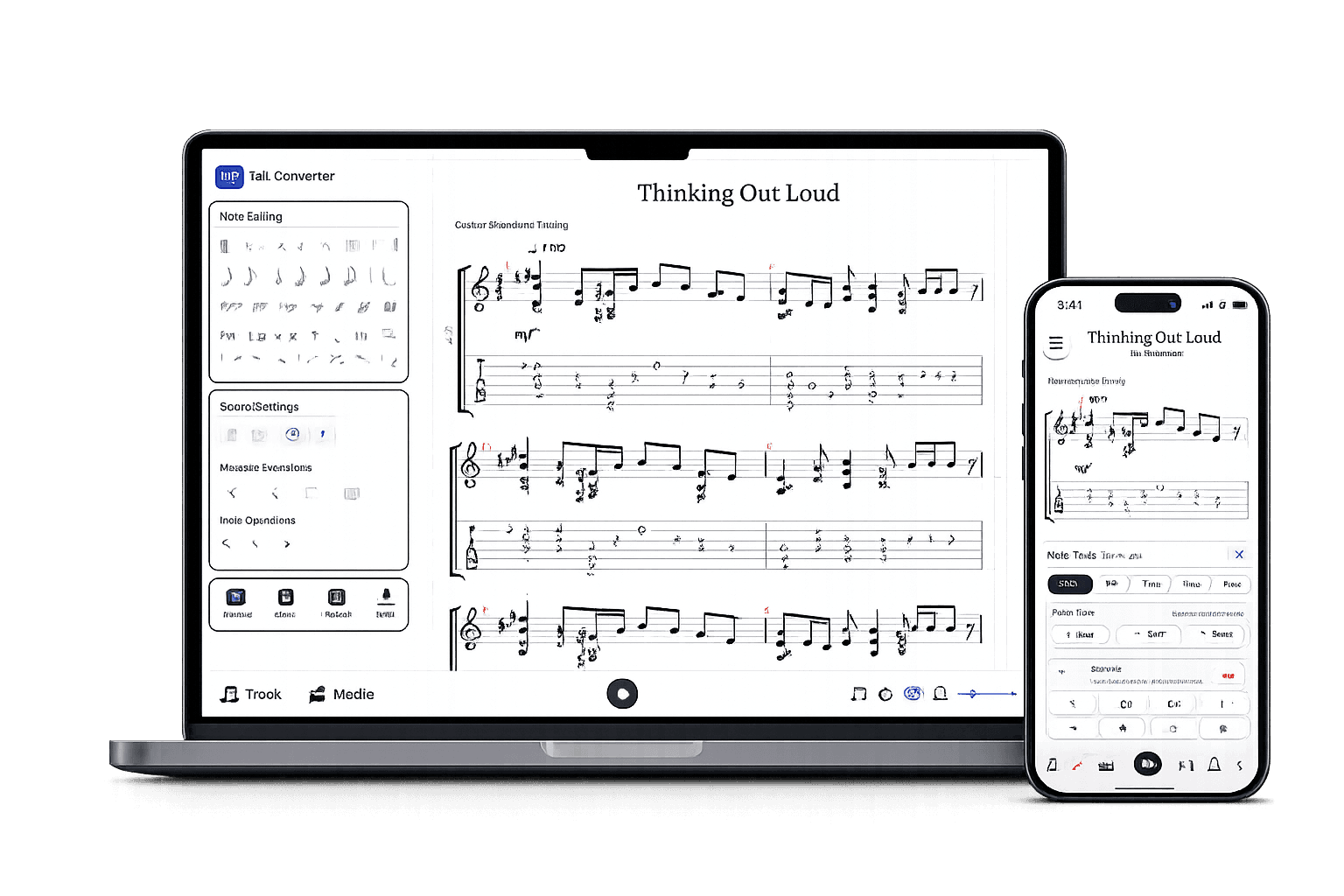
After the AI draft
A real tab editor, not a static download.
Play it back, edit any note, open GP5 or MusicXML you already have, and export in the format you need.
Edit the draft
Fix notes, timing, measures, and fret choices.
Check by ear
Play back, loop bars, match the source.
Export when ready
Guitar Pro, MIDI, PDF, MusicXML.
Bass tabs made by Tabtify
Open any of them in the editor: play along with media sync, change a note, export to Guitar Pro or PDF.
Master Of Puppets
Metallica
Sweet Child O' Mine
Guns N Roses
Smells Like Teen Spirit
Nirvana
Layla
Eric Clapton
Killing in the Name
Rage Against The Machine
Tommy the Cat
Primus
Fear Of The Dark
Iron Maiden
La Poderosa Hidden Track
Stick To Your Guns
Californication
Red Hot Chili Peppers
Here Cpmes The Sun
The Beatles
Thunderstruck
AC/DC
Cocaine
Eric Clapton
Frequently Asked Questions
Everything you need to know about Tabtify's AI-powered guitar tab creation platform. From audio conversion to professional export formats.
Can Tabtify pull the bassline from a whole song?
Which source gives the best bass accuracy?
Does it support 5- and 6-string?
Related converters
Other ways to start
Converter notes
From source to editable tab
These notes are here for setup context. The main workflow starts above in the converter, then continues in the editor.
- Start from an audio file, MIDI, recording, or public media link.
- Choose 4-, 5-, or 6-string bass before transcription for realistic low-register mapping.
- Best results from bass-forward mixes or isolated stems.
Steps
- 01Upload the song audio, start from MIDI, or paste a public media link.
- 02Choose the bass setup and 4, 5, or 6 strings; adjust tuning in Advanced if needed.
- 03Run the conversion and open the bass tab in the editor.
- 04Check the groove with playback, fix positions, then save or export.
Source quality
- Use guitar/bass-forward mixes or stems; the bass is easy to lose in a dense master.
- Set the correct string count so low notes map to sensible frets.
- Convert a verse or chorus first, then expand to the full song.
- In full commercial mixes, kick drum and low guitar overlap the bass and reduce precision.
- Slap, ghost notes, and slides typically need manual review.
- Use source material you have the right to transcribe.