
WAV to MIDI
If you are starting from a WAV, you are starting from the best case. Nothing has been compressed away, so the detector sees the full picture. Upload the stem, check the notes, export the .mid.
Or drag and drop here
MP3, WAV, M4A, OGG, FLAC, AAC, AIFF, MP4, WEBM, .mid or .midi
GP5, GPX, GP, MusicXML, MXL
Guitar, bass, 7-string or ukulele. Free export to Guitar Pro, MIDI, PDF, and MusicXML.
AI-Powered Guitar Tab Generation
Paste a link or file, get an editable draft, then play and export in the browser.
01
Paste a link or upload audio
YouTube, TikTok, Instagram, MIDI, or a recording.
02
AI writes the tab draft
Notes and rhythm land as an editable guitar tab.
03
Play, tweak, export
Loop hard bars. Export GP5, MIDI, PDF, MusicXML.
Use cases
What players convert here
Stems back to MIDI
Bounce a single track out of your session and get the note data back when the MIDI is lost.
DI and reamp tracks
A clean DI is close to ideal input, since there is no room noise or bleed to fight.
Field recordings
Convert an interface or field capture of a single instrument into something you can edit.
After the AI draft
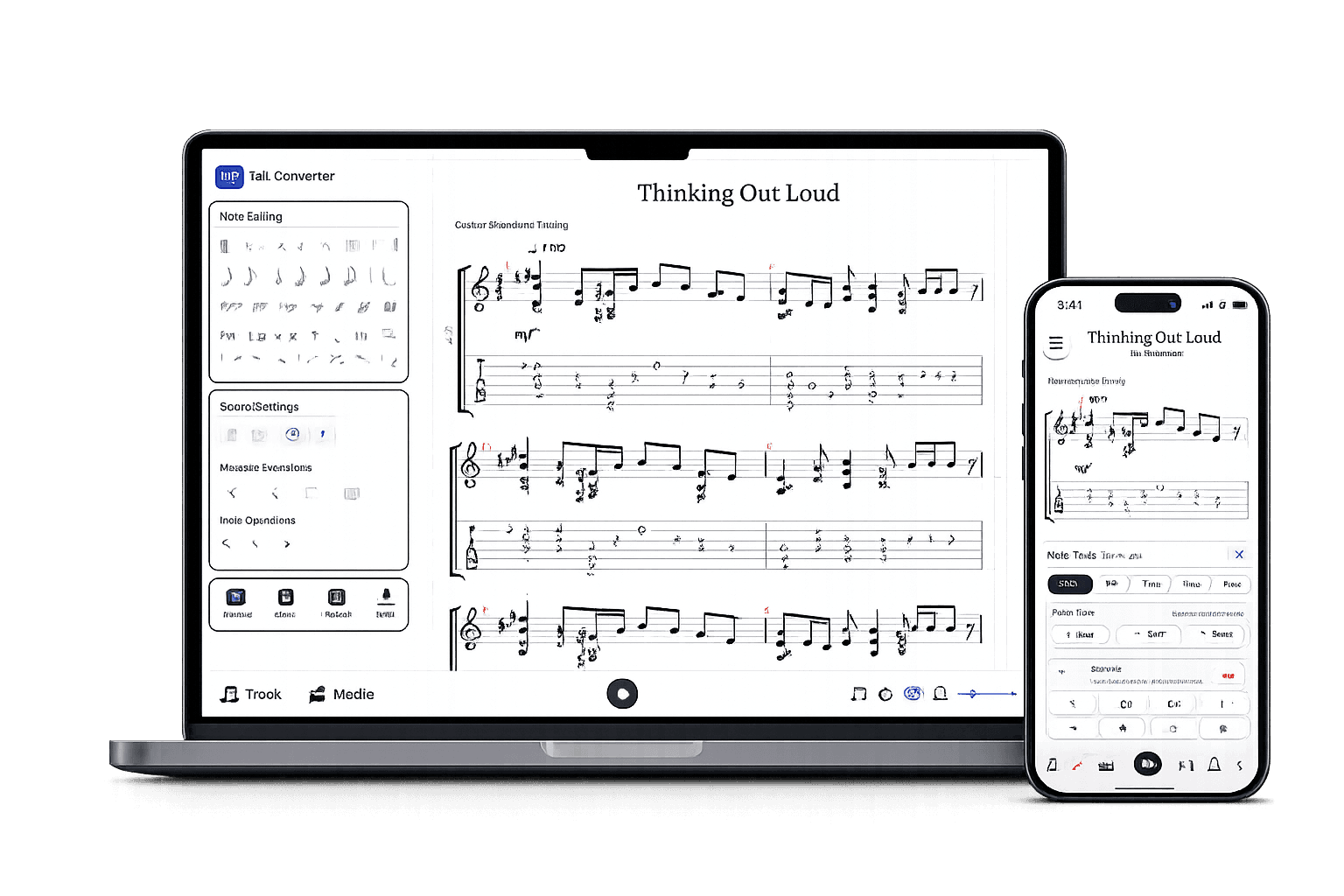
A real tab editor, not a static download.
Play it back, edit any note, open GP5 or MusicXML you already have, and export in the format you need.
Edit the draft
Fix notes, timing, measures, and fret choices.
Check by ear
Play back, loop bars, match the source.
Export when ready
Guitar Pro, MIDI, PDF, MusicXML.
Tabs made by Tabtify
Open any of them in the editor: play along with media sync, change a note, export to Guitar Pro or PDF.
Kashmir
Led Zeppelin
Layla
Eric Clapton
Master Of Puppets
Metallica
Do I Wanna Know
Arctic Monkeys
Thunderstruck
AC/DC
Cocaine
Eric Clapton
Hysteria (intro)
Muse
Welcome To the Jungle
Guns N Roses
Here Cpmes The Sun
The Beatles
Stairway To Heaven
Led Zeppelin
American Idiot
Green Day
Tears In Heaven
Eric Clapton
Frequently Asked Questions
Everything you need to know about Tabtify's AI-powered guitar tab creation platform. From audio conversion to professional export formats.
Does WAV really convert better than MP3?
Which sample rate should I export?
Can I upload a stereo stem?
Does the tempo come across?
Related converters
Other ways to start
Converter notes
From source to editable tab
These notes are here for setup context. The main workflow starts above in the converter, then continues in the editor.
- Handles uncompressed WAV, including 24-bit DAW exports.
- Built for stems, DI tracks, and interface recordings.
- Exports .mid with tempo intact so it lines up on your DAW grid.
Steps
- 01Export the WAV from your DAW, ideally one instrument on its own.
- 02Upload it in the Audio tab and set the instrument and tuning.
- 03Run the conversion and review the notes in the editor.
- 04Correct anything that drifted, then export MIDI.
Source quality
- Isolated stems transcribe better than a stereo mixdown, even a well-mastered one.
- Leave the dynamics alone. Heavy limiting flattens the velocity information.
- Trim count-ins so bar one starts on the first real note.
- WAV files are large, so uploads take longer on a slow connection.
- A full-mix WAV is still a full mix. Lossless does not solve instrument separation.
- Conversion is built around sources up to 15 minutes.