How-to
How to Read Bass Tabs
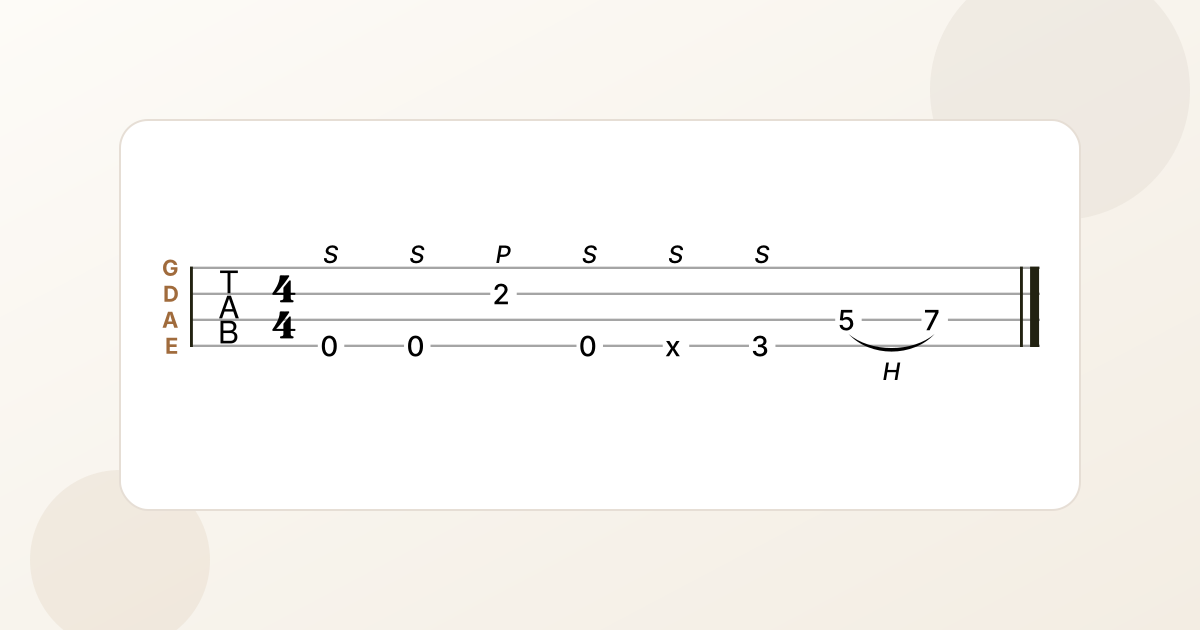
Bass tab has four lines, one for each string, with the thin G string on top and the thick low E at the bottom. A number on a line is the fret to press on that string, 0 is the open string, and you read left to right. That covers most bass tabs you will meet; the rest of this guide covers 5 and 6-string tabs, rhythm, and the symbols for slap, pop, ghost notes and harmonics, each drawn the way tab software shows it.
 By the Tabtify teamUpdated October 27, 20269 min read
In short: Bass tab has one line per string with G on top: numbers are frets, read left to right. Then every bass symbol, from slides to slap and pop.
Four lines, G on top
Each line of a bass tab is a string. The top line is the highest-pitched string, G, and the bottom line is the lowest, E, the same rule guitar tab uses. If you hold the bass and look down at it, the order looks upside down for a few days, then it stops mattering.
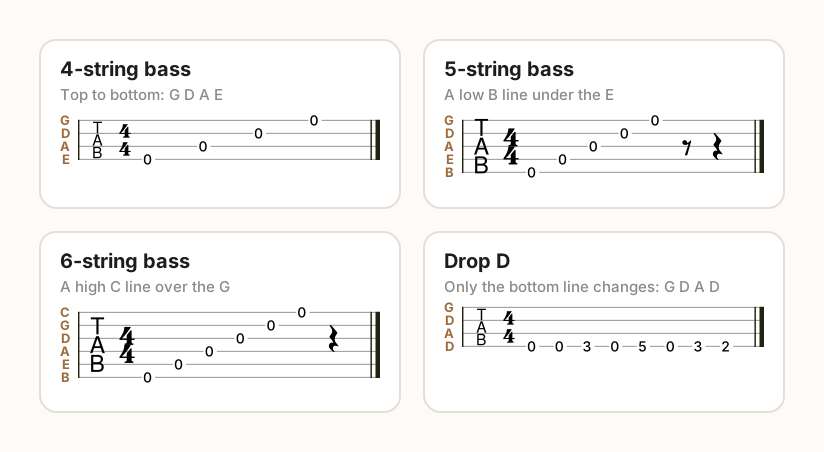
The number of lines tells you which bass the tab was written for. Five lines means a 5-string bass with a low B under the E; six lines adds a high C above the G. Some tabs print the string names at the left edge: if the bottom letter is D instead of E, the tab is in drop D and you need to tune your E string down a whole step first, by ear or with a bass tuner.
| Bass | Lines, top to bottom | What changes |
|---|---|---|
| 4-string, standard | G D A E | The common case |
| 5-string, standard | G D A E B | A low B line under the E |
| 6-string, standard | C G D A E B | A high C line over the G |
| 4-string, drop D | G D A D | Only the bottom string, tuned a whole step down |
| 4-string, D standard | F C G D | Every string a whole step down |
Frets, stacked notes and rhythm
Numbers are frets, read left to right. Bass lines are mostly one note at a time, so a stack of numbers in one column is rare: when you see one it is usually two notes played together, like a root with its octave or fifth.
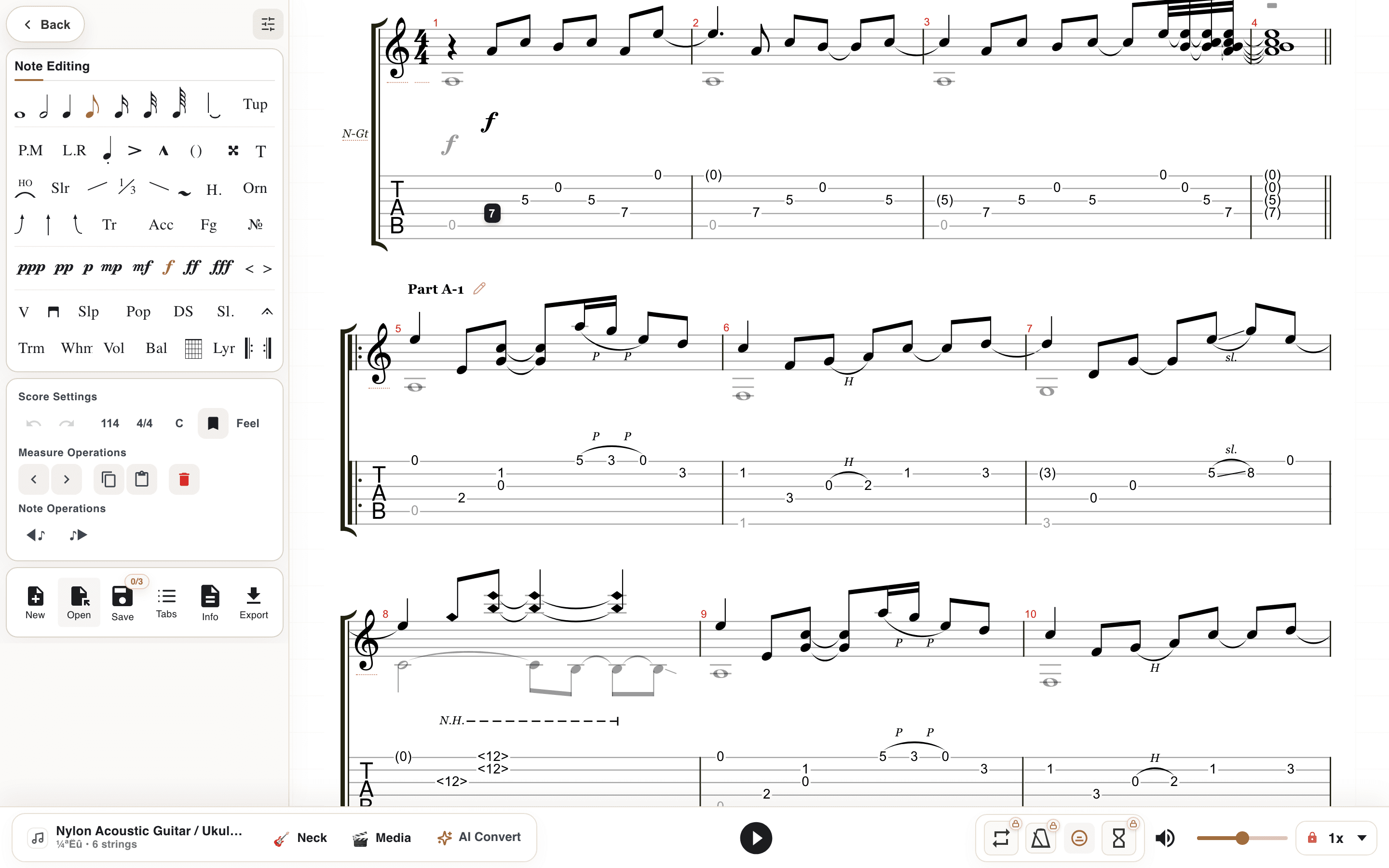
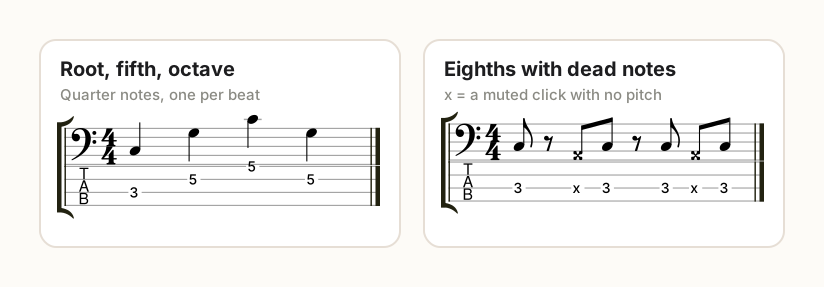
Rhythm matters more on bass than on almost any other part, because the bass line locks to the kick drum. Plain text tab leaves the rhythm out, so learn the line with the recording playing, and slow the recording down for fast passages. Tabs made in notation software carry the timing: on a Tabtify tab it sits in a bass clef staff above the tab, where a quarter note is one beat and a pair of beamed eighth notes shares a beat.
Fretting-hand symbols
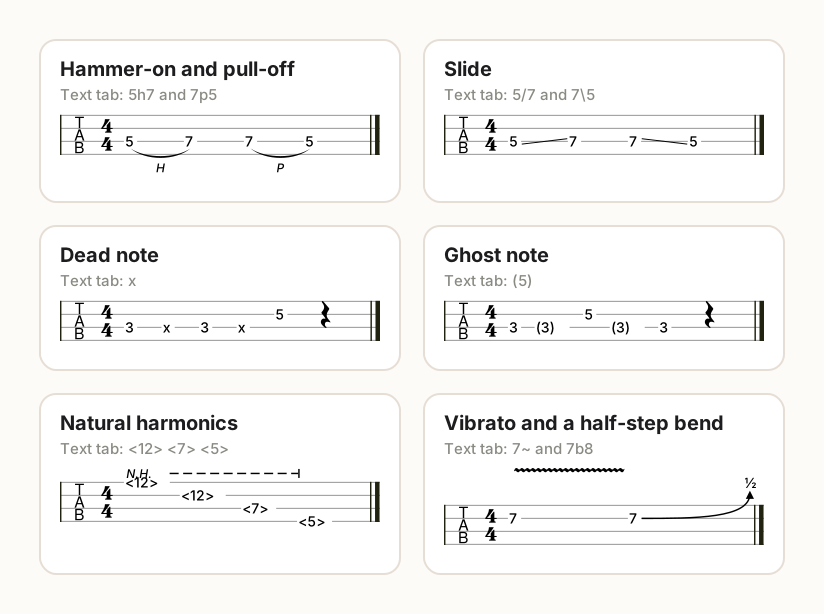
The fretting-hand symbols are the same ones guitarists use, and every guitar tab symbol reads the same way on bass. A few show up far more often in bass lines: muted notes for percussive grooves, ghost notes that are barely played, and natural harmonics, which ring clearly on a bass at the 12th, 7th and 5th frets. Bends are rare and small, usually a half step.
| Symbol | Text tab | What you do |
|---|---|---|
| Hammer-on | 5h7 | Pluck fret 5, then bring another finger down on fret 7 without plucking |
| Pull-off | 7p5 | Pluck fret 7, then pull the finger off so fret 5 sounds |
| Slide | 5/7, 7\5 | Keep the finger pressed and move it along the string |
| Dead note | x | Rest the finger on the string without pressing: a click, no pitch |
| Ghost note | (5) | Play the note very softly, more felt than heard |
| Natural harmonic | <12> | Touch the string over the fret wire without pressing, then pluck |
| Vibrato | 7~ | Rock the finger to make the pitch waver |
| Bend | 7b8 | Push the string until it sounds one fret higher |
Plucking-hand symbols: slap, pop and pick
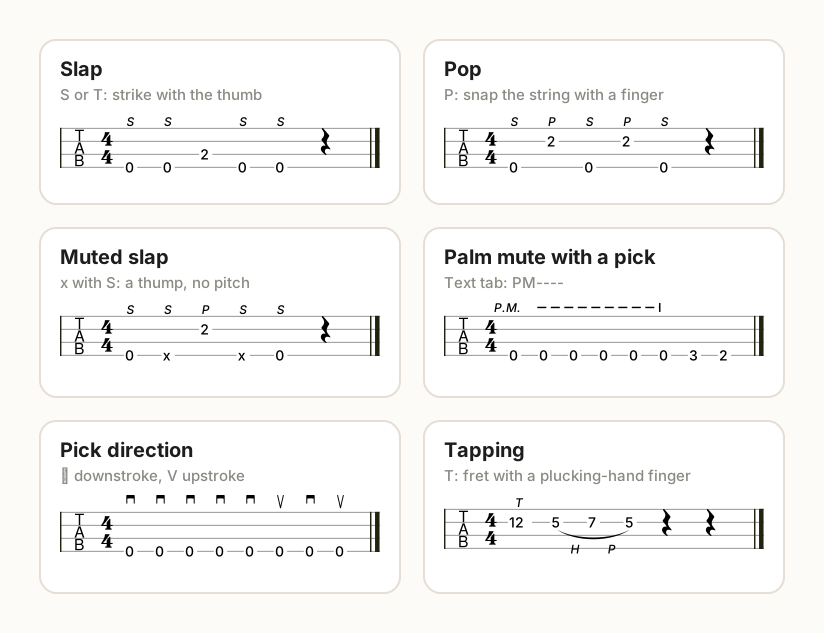
Slap tabs add letters above the notes. S (or T, for thumb) means slap: strike the string with the side of your thumb near the end of the neck. P means pop: hook a finger under a high string and snap it against the frets. An x marked S is a muted slap, a thump with no pitch that fills the gaps in a slap groove.
The letter p causes most of the confusion. A lowercase p between two fret numbers, as in 7p5, is a pull-off. A capital P over a single note is a pop. In tabs made with notation software the difference is visible: the pull-off letter sits on the arc that joins two notes, the pop letter stands alone above the staff. For bass played with a pick, ⊓ and V show the pick direction and P.M. means palm mute.
| Symbol | Where it sits | What you do |
|---|---|---|
| S or T | Above one note | Slap with the thumb |
| P | Above one note | Pop the string with a finger |
| x with S | Above a muted note | Slap a muted string for a thump |
| p (lowercase) | Between two numbers or on an arc | Pull-off, not a pop |
| ⊓ and V | Above the note | Downstroke and upstroke with a pick |
| P.M. | Over a dashed line | Rest the picking hand on the strings by the bridge |
| T over a high fret | Above the note | Tap the note with a plucking-hand finger |
Patterns you will see in every bass tab
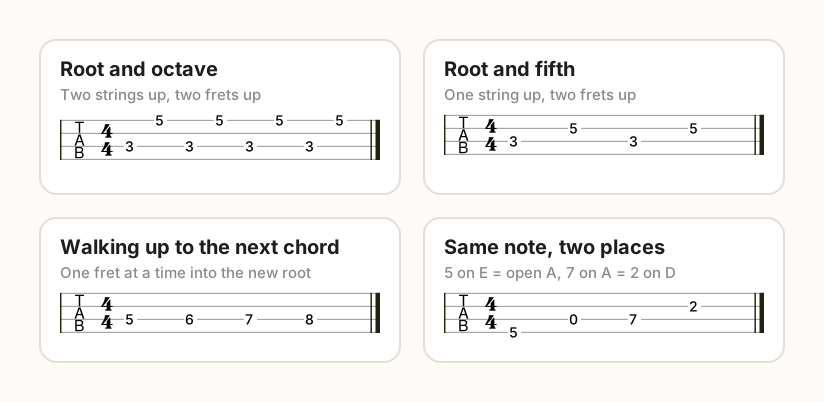
After a few tabs the same shapes keep coming back, and recognising them is what makes reading fast. In standard tuning each string is five frets above the one below, which gives bass its fixed shapes: the octave of any note is two strings up and two frets up, and the fifth is one string up and two frets up.
Walking lines lead into the next chord one fret at a time. And because the strings overlap, the same note has more than one place: fret 5 on the E string is the open A, fret 7 on the A string is fret 2 on the D string. A tab picks one of them; if another position is easier for your hand, use it.
- Root and octave: two strings up, two frets up
- Root and fifth: one string up, two frets up
- Walk-up: one fret at a time into the next chord's root
- Same note, two places: fret 5 on one string equals the open string above it
When the bass line has no tab
Many songs have guitar tabs and nothing for bass. Tabtify can draft one from a recording: choose 4, 5 or 6 strings and a tuning, and the bass line comes back as an editable tab with rhythm that plays against the original audio. Low notes are the hardest part of a dense mix to pick out, so treat the result as a draft and check it by ear, especially fast runs and notes that could sit on two strings.
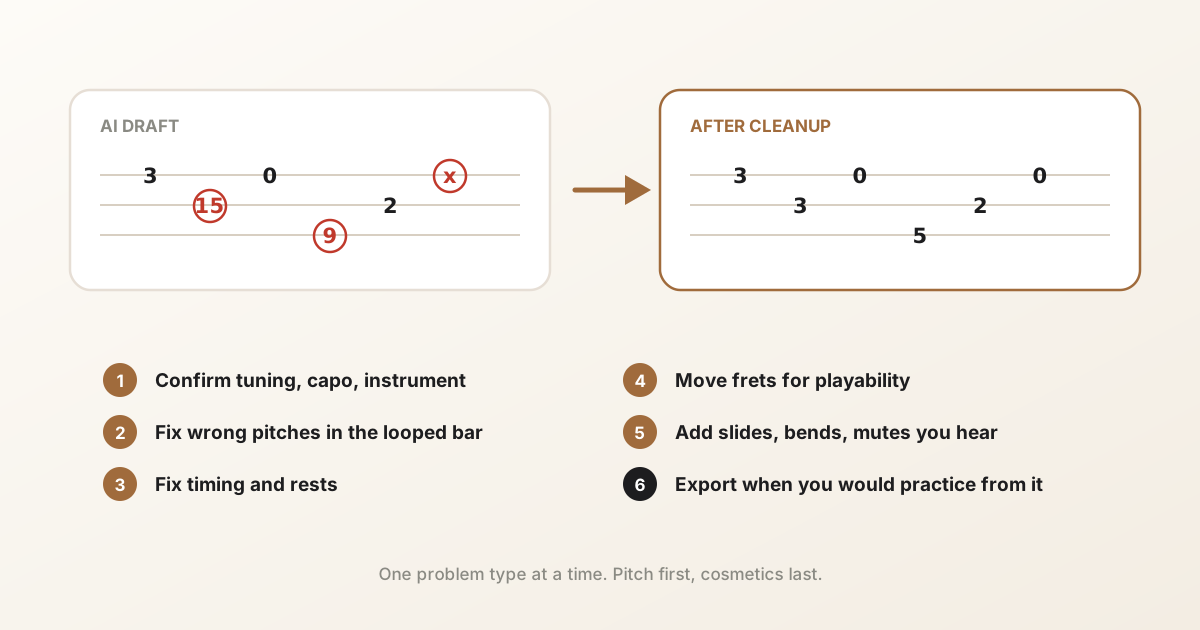
If you already worked out the line by ear, the bass line to tab use case shows how to turn your version into a clean tab, and the guide on how to clean up an AI draft covers what to check first.
Common questions
Why is the G string at the top of bass tab?
Tab puts the highest-pitched string on the top line, the way written music puts high notes higher on the page. On a 4-string bass that is G; the low E is at the bottom.
How do I play a 5-string bass tab on a 4-string bass?
Notes on the B line at fret 5 or higher can move to the E string, five frets lower: fret 7 on B is fret 2 on E. Notes on the B line below fret 5 are lower than a 4-string goes, so play them an octave up.
Does p mean pull-off or pop in bass tab?
Lowercase p between two fret numbers, like 7p5, is a pull-off. A capital P written above a single note in a slap part is a pop. In tab made with notation software the pull-off letter sits on the arc joining two notes.
Can I read guitar tab on a bass?
Partly. The bottom four lines of guitar tab are E, A, D and G, the same names as the bass strings, an octave higher. A riff on those lines can be played on bass from the same numbers; anything on the top two guitar lines cannot.
What does x mean in bass tab?
A muted note: rest the fretting finger on the string without pressing it down, so the pluck gives a percussive click instead of a pitch. With an S above it, it is a muted slap.
Have a recording of the part?
Upload it and get an editable tab draft you can check bar by bar against the original. Conversion is included with Pro.
Free tools
Next steps
Try it on your own recording
Related guides
All guides